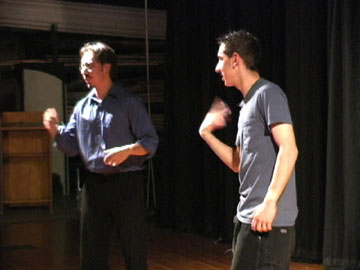
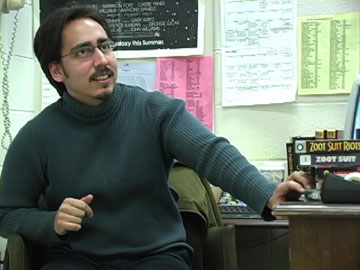
Gillian: How did this project the Denver North Digital Autodrama Project get started? What is its history and why is it important to you?
José: The history of this project, my history of it, started when I was in acting school, and it was an exercise my mentor at UCLA molded and created with acting students. The autodrama is based on the premise that art is essentially autobiographical. When I did it as a student, I was scared to death of the exercise. It’s basically the major moments of your life—very personal moments—and for five minutes you create a theatrical happening on stage. I decided to introduce it to my students in high school. I wasn’t introduced to it until I was in graduate school, but I thought that it would be interesting for them to tackle it because they are still at a young stage where they’re still innocent in a sense. And they’re not interested necessarily in performing or getting that job. They’re still finding out who they are. So it was a breakthrough for me as an actor, and as a human being, to go through this exercise.
When I introduced it to my high school students, I had already had them for a semester. These are advanced students, and I felt that they would be challenged by it but also feel safe in this classroom. This is an intimate setting; there are only fifteen students, as opposed to the larger classes that they have. They were scared and afraid to take on the project, but they’ve gone through some of the stages that I did. They’ve gone through revelations. They’ve learned a lot about themselves performing this autodrama, this exercise. For me, it was an opportunity to tap into the emotions that came out of doing the exercise when I was a student, and that’s why I was introducing the exercise to them. But I’m finding out that with the students, it’s the first opportunity that they’ve really been allowed to tell their story and to talk about themselves, so I borrowed this exercise from my teacher and I’ve been very impressed and flabbergasted by the performances of the students. They’re years ahead of where I was as a beginning acting student.
Gillian: Who are these students? Where do they live? How old are they? And why do the students think this project is important? Was it required?
José: It was definitely an assignment, and I think the initial reactions of the students were that they didn’t want to do that. They were constantly saying they didn’t want to do it, and a lot of them would challenge me with “If it’s personal, why should I talk about it?” There was a verbal challenge to it, but I think deep down they just weren’t sure they were ready to explore. But by forcing them to, what came out was beautiful. I think for those students who were skeptical at the beginning… I don’t want to say “skeptical.” Those who were vocally challenging the assignment, they ended up having the biggest breakthroughs on stage. These students are my advanced acting students, and they’re all local residents of the high school in northwest Denver. The majority of them come from low economic backgrounds. Most of them come from families with parents and siblings who have not yet gone to college. Most of these students have aspirations to go on with their education and study acting. And I want to provide them with that opportunity and teach them the skills to do that. I think for me what helped me become an actor was learning about myself and that’s what this project is about.
Gillian: You’ve asked Scott Slack and Scott Randolph to be involved with this project, to help with the editing process and help these young people voice their life experiences. What kind of reaction or experience would you like to result from this project?
José: I think the knowledge that they’ll have…they’ll have more tools for their tool belt to tell stories. I think that these kids are able to…. Digital media is their life. They’re familiar with it, and they learn very quickly. I’m trying to teach them traditional storytelling techniques and acting techniques. If we can collaborate with modern technology, that’s the future. These kids…. When I was growing up, pop culture was just being born, and these kids are immersed in it. That’s what they know. It’s a culture where ideas are mixed and synthesized, and so if we can mix this exercise with modern technology and use the two Scotts to help edit their ideas into a film, it’s something that they will be able to use forever. I don’t think a lot of them realized that, when they came into this class, about those possibilities. And that’s my goal and really all the teaching that I do is to let them know they can do it. Whatever they want to do, they can do it. We’ll provide you with some of the tools; now you go and write and create.
Gillian: What are the students’ expectations of this project? Is it purely informational or is there a higher goal?
José: Well, I think there’s definitely a goal that this may be a career for some of the students and they’ll definitely want to continue, not only here, but outside of school, outside of class. A lot of these students are at the sophomore or junior level, so my hope is that this can continue throughout their final year at Denver North High School but also outside. I’d love them to be able to, if we can get the equipment, create stories using digital media, and I think this is definitely sparking possibilities for future storytelling.
Gillian: How would the success of this project influence future projects similar to this one? And has this project been done before?
José: It’s never been done before, to my knowledge. This is the first time that we’re combining an acting exercise with the technology, and I’m hoping this will influence all our classes that we teach, including the freshman classes. I think it’s important for all teachers in public education to really use this technology, so I hope this will be able to infiltrate all our drama classes, all theater classes. There really needs to be this collaboration between technology and storytelling, the tradition of storytelling.
Gillian: If this venture proves to be successful, would you like to be involved in similar projects?
José: The autodrama is very unique, and it’s an incredible exercise but also one that cannot be used capriciously. I think the person involved with it needs to have had experience with it. It ventures on becoming…it should not become a therapy session, but at the same time it’s a cathartic experience for the students. I think the instructor needs to be well aware of the exercise but also be very open to having it documented on video camera, so that the students can watch themselves and learn about themselves, not only as they’re going through the exercise, but getting outside of themselves and watching themselves on screen. So I would love to be part of the project, not only here, but at other schools.
Gillian: Who do you think should see and benefit from these projects? What kind of audience?
José: I think we need to reach as broad an audience as possible. I think all students need to see this. I think parents need to see this. I think that’s why we digitized it to be on the Internet, because we can reach people through this project, and it’s truth. This is five minutes of truth and done in an entertaining way.
Gillian: How has this project impacted the lives involved thus far, from directors to teachers to the youth themselves and even their parents?
José: I think that the biggest impact for the students is the opportunity to talk about issues that they’ve been hiding for a while. It’s an opportunity for their voices to be heard, for them to use modern technology. As far as other teachers, it has yet to really outreach to them or to parents. It’s at such an early stage right now that they have yet to share this experience with their parents, but I think once it does reach the parents and reaches the teachers and reaches the public, it will have a tremendous impact.
Michelle: Do you mind if I ask you one more quick question?
José: Sure.
Michelle: What do you think the role of writing is in this project? How do you think it’s affecting them?
José: I think that’s a good question. I think the students are used to… One of the problems is that they love to improv; they love to get on stage and sort of fly without a net, which is great, which is what you need, but they lack elements of structure. So what writing is helping them do is be specific, be focused. If we can allow them to really think about their ideas and get them on paper, and if we combine that with the element that is instinctual, to get on stage, then I think that’s where the stories are going to benefit. The requirement was for the exercise to be five minutes, and they were frankly concerned about being able to fill those five minutes. But when they performed, some of them went on to ten, twelve minutes. But the writing has helped them focus their major ideas, the major points honed down to a five-minute piece, and that’s an element that the two Scotts are helping me learn how to teach. It’s very important.
Back to Digital Autodrama Project Main Page